What if I told you that one of the biggest differences between a man who is financially struggling and a man who is building wealth isn't the size of his paycheck?
It could be what he owns.
Many men work hard for years, earn money, pay bills, buy things, and start the cycle all over again.
But at the end of those years, they have very little that continues creating value for them. That's the problem.
Income can pay your bills. Assets can help build your future.
And you don't need to be a millionaire to start owning assets.
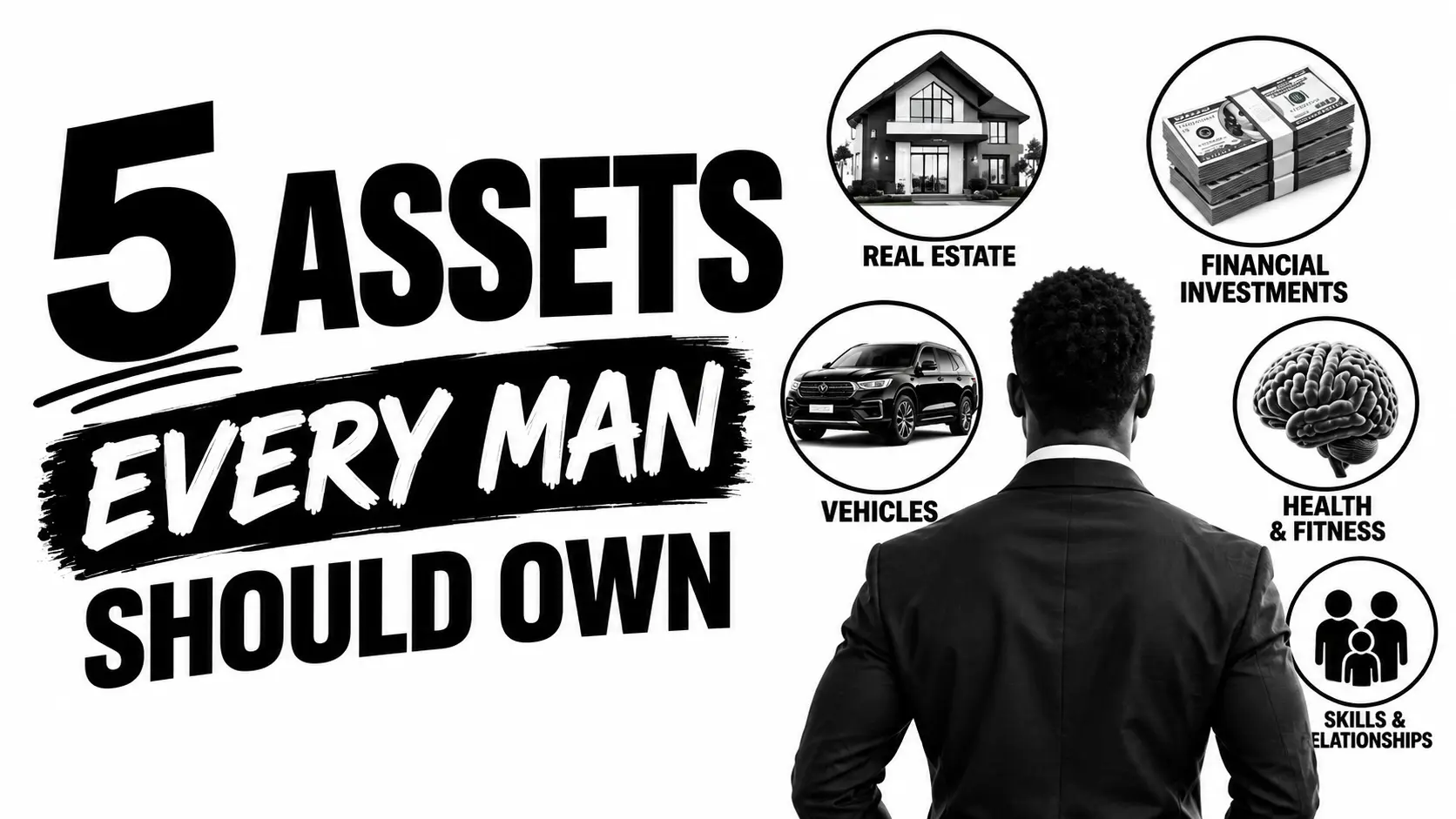
In this article, we're going to talk about 5 assets every man should consider building or owning—and why each one can make you stronger financially and personally.
1). A Skill That People Will Pay For.
Before we talk about property, investments, or businesses, let's start with an asset that you carry everywhere you go: Your skills.
A valuable skill can become one of the most powerful assets you ever own. Think about it.
>> If you know how to design, you can provide design services.
>> If you know how to repair computers, you can solve problems for customers.
>> If you know how to sell, you can help businesses generate revenue.
>> If you know how to write, edit videos, build websites, teach, repair equipment, install systems, or manage projects, your knowledge can create income.
And unlike a physical object, a skill can travel with you.
You can lose a job, You can lose a business, You can lose equipment.
But if you have developed a valuable skill, you still have the ability to create value.
That's why every man should continuously invest in himself.
Don't just ask:
"How much money do I have?"
Ask:"What can I do that people are willing to pay for?"
Then become better at it.
Learn.
Practice.
Get experience.
Solve real problems.
Your goal should be to develop skills that are useful, valuable, and difficult to replace.
Because your first asset isn't necessarily something you keep in a bank. It's what you can do.
2). An Emergency Fund.
This may not sound as exciting as owning a business or property, but it can completely change how you handle life.
An emergency fund is an asset of financial stability.
Life doesn't always follow your plans.
Your car can break down.
Your equipment can fail.
Your business can have a bad month.
You can face an unexpected expense.
And when you have no savings, an emergency can force you into expensive debt.
That's why every man should work toward building a financial cushion.
Start with a realistic target.
Maybe your first goal is simply saving a small amount consistently.
Then gradually build toward enough money to cover essential expenses for a period of time.
The exact amount will depend on your income, responsibilities, and circumstances.
But the principle is simple:
Don't let every unexpected expense become a crisis.
An emergency fund gives you breathing room.
It gives you time to think.
It can prevent you from making desperate financial decisions.
And it creates something every man needs:
financial resilience.
You don't build an emergency fund because you expect something bad to happen.
You build it because you understand that life is unpredictable.
3). Productive Investments.
Now, investing isn't about getting rich overnight. And it isn't about putting your money into something simply because someone on social media says it will make you wealthy.
Investing requires understanding.
Depending on your circumstances and where you live, productive investments could include diversified funds, shares, bonds, or other legitimate investments.
The important idea is that your money should have an opportunity to participate in creating value rather than simply sitting idle or being spent immediately.
Imagine receiving money and using all of it to consume.
- Food.
- Entertainment.
- Clothes.
- Gadgets.
- Parties.
Eventually, the money is gone.
But imagine consistently directing part of your income toward investments.
Over time, those contributions can potentially grow.
Don't invest in something you don't understand.
Don't risk money you cannot afford to lose.
And don't confuse investing with gambling.
The goal isn't excitement.
The goal is long-term wealth building.
4). A Business Or Ownership In A Productive Venture.
That could mean building your own business or having an ownership stake in a productive venture.
Why is ownership powerful?
Because when you work only for a wage, your income is generally tied to your labor.
But when you own a business, you have the opportunity to build systems, serve customers, employ people, create products, and generate value on a larger scale.
Of course, business ownership comes with risk.
A business can fail.
Customers can disappear.
Costs can increase.
Competition can become stronger.
So don't romanticize entrepreneurship.
Build carefully.
Start small if necessary.
Understand your market.
Solve a real problem.
Keep your expenses under control.
Learn how to sell.
Learn how to manage cash flow.
Build a reputation for reliability.
And reinvest intelligently.
You don't have to start with a huge company.
A small service business can teach you lessons that no motivational video can teach you.
The goal is to move from simply asking:
"Who will employ me?"
to also asking: "What can I build?"
5). Property Or A Place That Creates Value.
For many men, property can become an important part of a long-term wealth strategy.
This could be land, a home, commercial property, rental property, or another form of real estate that makes sense for your financial situation.
But there's an important distinction:
Not every property automatically makes you wealthy.
A property can cost you money through maintenance, taxes, financing, vacancies, or other expenses.
So don't buy property simply because someone tells you:
"Land always makes you rich."
Do your research.
Understand the location.
Understand ownership and legal documentation.
Understand financing.
Understand expected income and expenses.
Understand the risks.
The goal is to own property that fits your financial plan and, where appropriate, can preserve or create value over time.
And for many men, owning a place to live can also provide stability.
Property is not a magic shortcut to wealth.
It's a tool.
And like every tool, its value depends on how wisely you use it.
Bonus Asset: Your Reputation.
Now here's an asset that many men overlook: Your reputation.
People may not call it an asset, but it can have enormous economic value.
Think about the man people trust. When he says he'll deliver, he delivers.
When he makes a mistake, he takes responsibility.
When he takes someone's money, he provides what he promised.
When he starts a business, people recommend him.
When an opportunity appears, people think of him.
That's the power of reputation.
Your reputation can bring you customers.
It can bring partnerships.
It can bring employment opportunities.
It can bring referrals.
It can open doors.
And it takes years to build but only moments to damage.
So protect your name.
Be reliable.
Be honest.
Keep your word.
Treat people well.
Your reputation follows you.